So… did you hear the news last week?
The 2026 Dietary Guidelines for Americans were officially released on January 7th, 2026, along with a refreshed version of the familiar food pyramid. And if you’ve felt confused, overwhelmed, annoyed, or even a little skeptical reading the headlines, you’re not alone.
For busy moms and women who already feel tired, bloated, or hormonally off, these announcements can feel like yet another set of rules you are supposed to follow perfectly. One year fat is the enemy, the next year it is eggs, another year it’s a specific a food group. One decade carbs are king, the next they are controversial.
I want to help you understand what these guidelines actually are, why they feel so loud right now, and why they may not be the best roadmap for your personal health.
These Guidelines Sound New, But the Structure Has Not Really Changed
Every time a new set of dietary guidelines comes out, it is framed as groundbreaking. But when you zoom out, the foundation looks very familiar.
Why the messaging feels louder this time
The nutrition conversation today is happening in a much noisier environment.
Social media, political tension, and public distrust of institutions have turned what used to be a quiet policy update into a viral debate. RFK Jr, MAHA, etc. make it all debatable. The guidelines themselves are not radically different from past versions, but the way they are being discussed makes them feel new and urgent.
The same framework, repackaged
The core structure of the dietary guidelines has stayed relatively consistent for decades. Emphasis on food groups, calorie ranges, and broad nutrient targets continues, even when the language or visuals change. This time the focus on reducing highly processed foods, back to “real foods” is the center of their messaging.
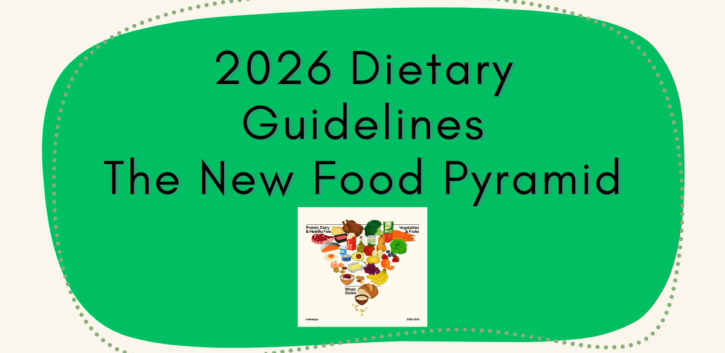
We haven’t used a “Food Pyramid” since 2011, but they brought that back, replacing the MyPlate guide. So the visual itself is different, with the protein at the top as priority along with fruits and veggies, putting grains at the bottom (watch my video for how I do not think this is showing you should eat keto).
For women already struggling with fatigue, hormone symptoms, or digestive issues, this can feel frustrating. You are trying to listen to your body, yet the advice feels generic and disconnected from real life.
The Dietary Guidelines Are Written for Populations, Not Individual Women
This is one of the most important points that gets missed.
The 2026 Dietary Guidelines are designed for population level nutrition programs, not for you as an individual woman trying to feel better in your body.
What population based guidelines actually mean
These recommendations are created to guide large scale programs like:
- WIC programs for women and children
- School breakfast and lunch programs
- Some senior nutrition and care facilities
They are meant to work reasonably well for millions of people at once, not optimally for one specific person.
Why individuality is completely missing
The guidelines do not account for:
- Hormone changes like perimenopause or postpartum recovery
- Chronic fatigue or burnout
- Digestive issues like bloating or irregular bowel habits
- Blood sugar instability
- Stress levels or sleep quality
When I work with women one on one, we focus on exactly these factors. That level of personalization simply cannot exist inside a national guideline.
How These Guidelines Shape Government Funded Food Programs
Even if you think the dietary guidelines do not affect you, they likely do in indirect ways.
Programs directly controlled by the guidelines
The dietary guidelines dictate food choices for programs like school meals, WIC, and senior care. That means the food available to children, pregnant women, and older adults is directly tied to these recommendations.
Why SNAP changes may be coming
While SNAP currently does not enforce dietary restrictions, restrictions cannot be implemented without a universal standard. The newly released guidelines provide that framework.
Based on how policy typically evolves, it is very likely we will see SNAP program changes in the future that align more closely with the 2026 Dietary Guidelines.
Food Industry Influence Has Always Been Part of the Process
This part often surprises people, but it should not.
Food industry involvement in the Dietary Guidelines for Americans is not new. It has existed since the guidelines were first introduced in the 1980s. You should read the book, “Death by Food Pyramid” if you are into this type of history.
What transparency actually looks like
Committee members are required to disclose financial relationships, and many have ties to organizations such as:
- Major food manufacturers
- Commodity groups
- Beef and dairy associations
- Large agricultural organizations
These disclosures are considered transparent, but they still influence which questions get asked and which recommendations stay the same decade after decade.
Why some recommendations never change
When you understand how research funding, committee structure, and institutional momentum work, it becomes clear why certain dietary messages remain remarkably consistent over time, even as individual health outcomes continue to decline.
It means structure, incentives, and access shape policy in powerful ways.
What This Means for Tired Women and Busy Moms
If you are exhausted, bloated, struggling with weight changes, or feel like your hormones are off, the problem is not that you are failing the dietary guidelines.
The problem is that the dietary guidelines were never designed to solve individualized health issues.
They are a starting point for institutions, not a diagnostic tool for your body.
My Take as a Dietitian of Nearly 15 Years
I go much deeper into the history, structure, and real world impact of the 2026 Dietary Guidelines in my YouTube video. I also explain why confusion around nutrition keeps increasing, even though information is more available than ever.
If you want a clearer understanding of who these guidelines are for, who they are not for, and how to think about them without feeling overwhelmed, that video will help connect the dots.
Final Thoughts
If nutrition advice keeps feeling confusing, conflicting, or exhausting, that is a signal to stop looking for answers in population based rules and start paying attention to how your own body is functioning.
You are not broken. The system was just never designed with your individuality in mind.